
Paul Higgins, Commercial Director at tuffX, explores the growing demand for energy-efficient, futureproof glazing solutions and explains why housebuilders and developers who embrace innovation today have the opportunity to lead the market, not chase it
Building for the future
As the UK housebuilding industry enters another period of regulatory transition, there’s a growing opportunity for developers and builders to get ahead of the curve on energy-efficient design, particularly when it comes to highperformance glazing.
The drive for sustainability is being led by both regulations and buyers who are increasingly prioritising homes that offer lower running costs, a reduced carbon footprint and optimum thermal comfort. In fact, recent data shows that buyers are willing to pay an average 3.4% premium for energy-efficient homes. For developers, this means that specifying efficient roof glazing solutions isn’t just about compliance – it’s now becoming a clear market differentiator.
For developers and housebuilders, specifying next-generation glazing systems today ensures compliance with current standards and readiness for future ones. Products that combine aesthetic quality, thermal efficiency, and low-carbon credentials not only enhance the sustainability profile of a project but also appeal to increasingly eco-conscious buyers. In short, those investing now in advanced, sustainable glazing solutions will be best placed to meet future regulations seamlessly, while delivering homes that perform as beautifully as they look.
Low-carbon glazing
Across the industry, developers and contractors are increasingly specifying lowcarbon materials as part of broader decarbonisation strategies and the development of low-carbon glass represents a significant advancement. By addressing embodied carbon at the manufacturing stage, this new generation of glass reduces construction-related emissions and contributes to the sustainability of homes.
The introduction of low-carbon glass demonstrates the potential for material innovation to make a measurable impact on the carbon performance of new housing developments and renovation projects. As embodied carbon becomes an increasingly important metric, materials of this type are expected to play a growing role in the net-zero journey. TuffX was the first UK manufacturer to produce low-carbon glass that delivers equivalent optical clarity, strength, and durability to conventional float glass while substantially reducing embodied carbon.
Produced entirely using renewable electricity and incorporating 64% recycled content, the glass achieves a verified carbon footprint of 6.64 kg CO₂/mÇ (for 4 mm glass), representing a 42% reduction compared with standard production processes. Designed to withstand the test of time, TuffX low-carbon glass also reduces the frequency of replacement regardless of external factors like weather, temperature fluctuations, or normal wear and tear.
As a result, this superior-quality solution has a longer lifecycle, lessening the need for maintenance tasks like cleaning and repairs, as well as the environmental burden of replacement.
Solar control solutions
With summer temperatures now regularly approaching or exceeding 40°C, overheating has become a real design challenge. It affects not only occupant comfort but also increases reliance on energy-hungry cooling systems. While the Future Homes Standard (FHS) remains on the horizon, Approved Document O already sets the framework for reducing overheating in new homes. Integrating advanced solar control glazing at the design stage helps ensure compliance with Document O while also meeting the growing market demand for sustainable, low-energy homes.
Alongside its environmental benefits, solar control glass offers a practical, passive solution to overheating by reflecting up to twice as much solar heat as standard glazing. Without a visible tint, TuffX’s Infinity rooflight maintains maximum daylight and aesthetic appeal while reducing reliance on air conditioning.
With a U-value as low as 1.0 W/mÇK, this untinted solar glass delivers exceptional year-round performance, providing both insulation in winter and cooling efficiency in summer.
Double-duty heated glass
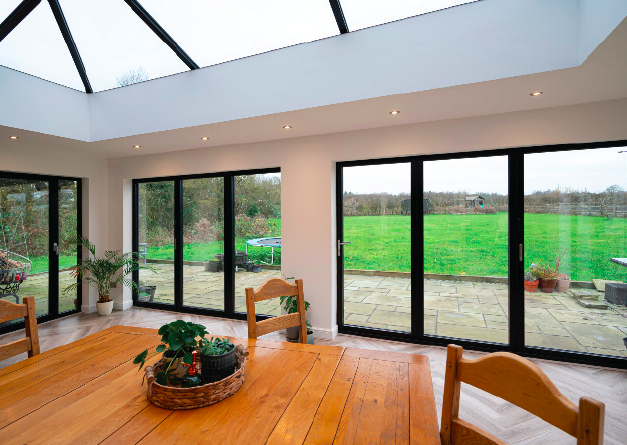
Glass is set to play a significant role in helping housebuilders and developers meet the anticipated stringent new standards. One product innovation addressing the regulations and the need to deliver thermal comfort is heated glass for bi-fold doors. TuffX’s Glow-heated glass comprises a sealed unit layered with an intelligent, invisible conductive coating that is electrically heated to convert electric power into radiant heat.
The glass surface temperatures reach 35-40°C, which are controlled via a wallmounted thermostat. This also enhances interior floorplan and layout opportunities as it frees up wall space where traditional radiators would typically need to be placed.
This radiant heat technology has an average hourly cost of around 9p per bi-fold door, so, for example, a threedoor TuffX Glow-heated glass bi-fold configuration running for five hours per day will cost around £1.35 (based on a electricity cost of 25p/kWh).
For ease of sequencing, as heated glass units are glazed similarly to conventional double-glazed units, installation is standard. The electrical connections need to be carried out by a qualified electrician directly into the properties’ 240V mains supply.
For further information about Tuffx, visit www.rdr.link/dbh029