Sustainability is a core topic and key consideration within the built environment. But what role does time have to play? Here, Aimee Fletcher, Product and Design Manager at EGGER UK, explores the concept of sustainable future design in more detail…
When it comes to sustainability and constructing the greener homes of the future, it’s not enough to just look at how a building product or material is manufactured. While the raw materials and production processes are integral to its environmental credentials, true sustainability goes far behind that, requiring a careful consideration of the future.
Sustainable future design, or designing for the future, is about more than just a box ticking exercise – it’s about changing the way we think. It’s on us as manufacturers, specifiers, housebuilders and developers to ensure that our building finishes and aesthetics remain on trend for longer, that the products and systems being specified are built to last, and that interior living spaces are designed with ergonomics in mind.
Timeless trends
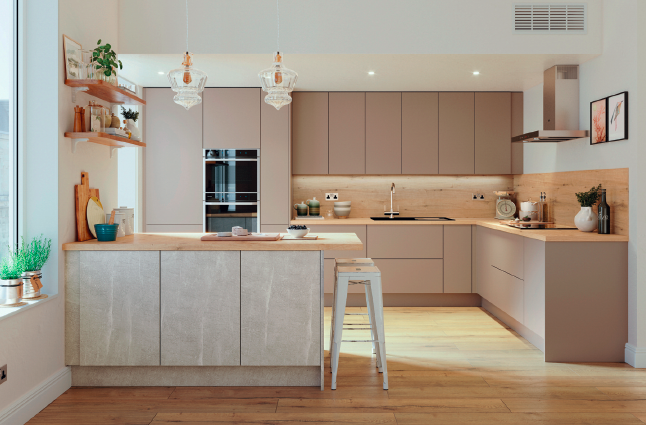
From flooring to built-in bedroom furniture and kitchen cabinetry, these are the exciting finishing touches chosen by a homeowner. With the rise of social media and the digital world, the desire to be ‘on trend’ is more prevalent than ever, having a strong influence on purchasing decisions. No one wants to invest in a new kitchen, for example, only for it to look tired and dated after just a couple of years. Indeed, with all the work and resources that have gone into its production, you will want it to remain inuse for as long as possible. With this in mind, opting for timeless aesthetics when it comes to flooring, builtin furniture and cabinetry is invaluable. As well as providing longevity to the space, ensuring it remains ‘on trend’ for longer, it also ensures the carbon contained within the products and materials is locked away for longer. One safe bet is biophilic design – a trend that is clearly here to stay – and its nuances of natural looking finishes like timeless stones and elegant wood effects. In fact, when you consider that the very word ‘sustainability’ often conjures up images of nature, the outdoors, leaves and trees, biophilic design really is the perfect match.
At EGGER, our focus is on curating collections and colour concepts that can be easily combined and updated, creating a harmonious, complementary and on trend look throughout a home.
Quality that is built to last
Whether it’s a new home or new kitchen, either is a significant investment by the buyer. As such, it’s important that the finishes provided stand the test of time. Specifying quality materials and products is another way you can indirectly deliver on sustainability, providing long-lasting, reliable performance. This mindset is particularly important when you consider the time invested into timber products. While wood is an inherently renewable and natural material, the trees we are planting now won’t be ready to harvest and use within manufacturing for another 40-50 years.
Today’s forestry teams are really out working for the future of the built environment. With trees taking such a significant length of time to grow to maturity, it’s only right that we are making a product from this investment that mirrors its longevity and continues to lock away carbon for decades to come.
Designing for future users
Thinking about the end user is an obvious part of housebuilding and interior design, but this shouldn’t be limited to just today’s end user. What about 10, 20 or even 30 years down the line; how will their needs have changed? This is where ergonomics should be considered, the scientific discipline that involves designing products and environments to match the individuals who use them.
It’s no secret that we have an aging population. In 2026, 26% of the population will be over 65 and by 2050, the world’s 60+ population will account for over two billion people. This raises the question of how can we ensure we are designing homes today that are fit for these future generations?
By designing with functionality, accessibility and use-ability in mind, it not only increases the longer-term use of the furniture or space (linking back to. sustainable futures), but it can also support healthier aging outcomes for the users. By adopting the mindset that design inspiration cannot come at the cost of functionality, we are truly contributing to legacy pieces of household furniture.
Looking to the future
It’s no longer enough to just examine a product’s environmental credentials. Instead, it’s important to ask other questions of it, including how long it will last? Is it suitable for today’s users or also someone 20 years down the line? Is the colour on trend and will it remain a timeless aesthetic?
At EGGER, longevity is at the core of everything we do – not just from an environmental perspective but also from that of design, production and functionality. Learn more about our decorative solutions for flooring, furniture and surfaces online or by visiting our EGGER LONDON showroom at 1 Dallington Street, London, EC1V 0BH.
For more information go to www.rdr.link/dbh028