Sustainable Drainage Systems (SuDS) are an increasingly vital tool in modern housing developments.
They are designed to drain surface water run-off in a manner that replicates the natural water cycle. By storing and reusing surface water at its source, SuDS decrease flow rates to water courses and improves overall water quality.
The mandatory adoption of SuDS through Schedule 3 was expected in 2024 but has still not materialised, despite the increasing strain on often outdated, oversaturated water systems and infrastructure. The government has continued to focus on guidelines – rather than legislation – which is creating both confusion and uncertainty. As a result, housebuilders face pressure to deliver high-quality, sustainable schemes whilst navigating tight budgets and time constraints in a vague regulatory landscape.
Bringing manufacturers in at the concept stage
One of the biggest barriers to SuDS adoption is uncertainty: what solutions are suitable for a given site, how should the system integrate with landscaping and infrastructure, and how can maximum performance be guaranteed?
Developers are often faced with juggling multiple teams and tight schedules, which is why manufacturers should be involved from the get-go. The onus is on technical teams to work closely with developers and other customers to assess site conditions and recommend systems tailored to space, budget, and planning requirements. This collaborative approach ensures a smoother design process and reduces potential delays during later stages of development.
Confusion or lack of knowledge around specifying and installing SuDS is still prevalent, but manufacturer-led education can play a key role in building up confidence across the industry. The rollout of SuDS manuals and technical guides can simplify design principles, clarify terminology, and explain performance expectations to developers, increasing understanding of how systems work in real-world scenarios. Empowered with this Richard Eddy, Category Manager for Underground & Utilities at Polypipe Building Products, explores the role that manufacturers can play in demystifying SuDS for developers throughout the design, specification, and installation processes, allowing the potential of systems to be maximised on site knowledge, developers can avoid costly mistakes, accurately estimate costs and deliver systems that perform as intended.
Making installation practical and economical
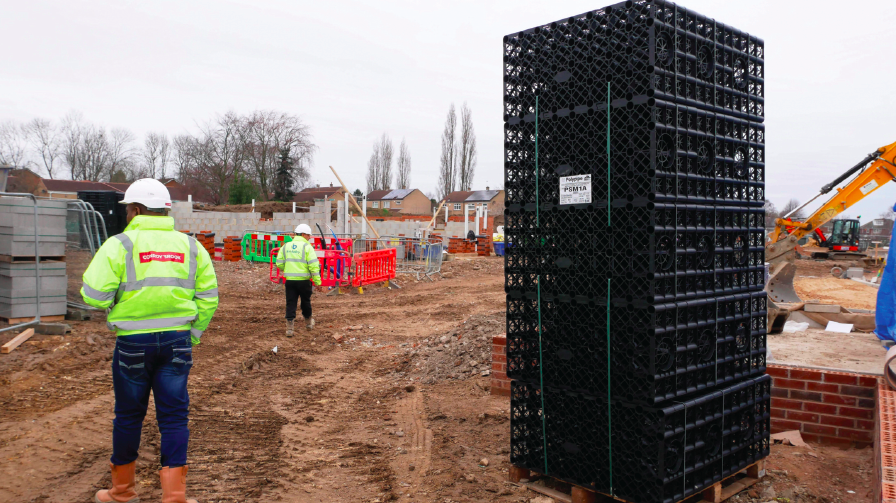
Whilst a SuDS design may look good on paper, issues on site, such as unexpected soil conditions, limited space, or site access, can complicate installation.
The overarching principle of SuDS design is that surface water runoff should be managed for maximum benefit. The various types of benefits fit into four categories known as the four pillars of SuDS – Water Quantity, Water Quality, Amenity and Biodiversity. When developers have an expert partner in their corner, they can implement these principles, foreseeing and addressing challenges before they arise.
Support during the installation phase is also key. Every project comes with its own set of unique obstacles, so sitespecific advice can ensure seamless integration of systems with the broader construction schedule.
Unlocking the benefits on site and beyond SuDS do more than simply manage surface water. When designed correctly, they can also improve biodiversity, create greener spaces, and provide aesthetic value to the development. Offerings extend to blue-green roofs, ponds, and swales, as well as tree pits and podium decks – creating additional environmental benefits whilst providing vital greenspace for developments.
SuDS also serve as a great marketing tool, demonstrating commitment to sustainability and compliance with modern environmental standards. With clear design, accurate specification, and effective installation, SuDS can enhance both the physical quality of a development and its appeal to buyers, who increasingly look for homes with sustainable features.
Moreover, a well-designed SuDS can reduce long-term maintenance costs, as systems will be more effective at controlling surface water runoff, which, if left unchecked, can lead to flooding and property damage in the future. These benefits can offer both short-term and long-term value to developers, making SuDS an essential component of every modern housing development.
Bringing SuDS clarity to developers SuDS do not need to feel complex. The right manufacturer partnership can transform them into practical, well-understood, and high-value components of a development. We aim to bridge the gap between planning and practical delivery, ensuring that SMEs can adopt SuDS with confidence.
By embracing the expertise of manufacturers from the start, developers can focus on what they do best – delivering high-quality, sustainable homes while maximising the value of their developments in the process.
Polypipe Building Products has been pioneering SuDS solutions for over two decades, with our systems widely used in UK residential projects of all sizes. With an in-depth understanding of the regulatory landscape, including planning conditions and local authority requirements, we provide developers with the guidance needed to navigate these regulations with ease.
For more information go to www.rdr.link/dbg029